
Jean-Philippe Rameau
The Classical PeriodThose who wish to learn are not concerned about the method used to instruct them, as long as that method succeeds."
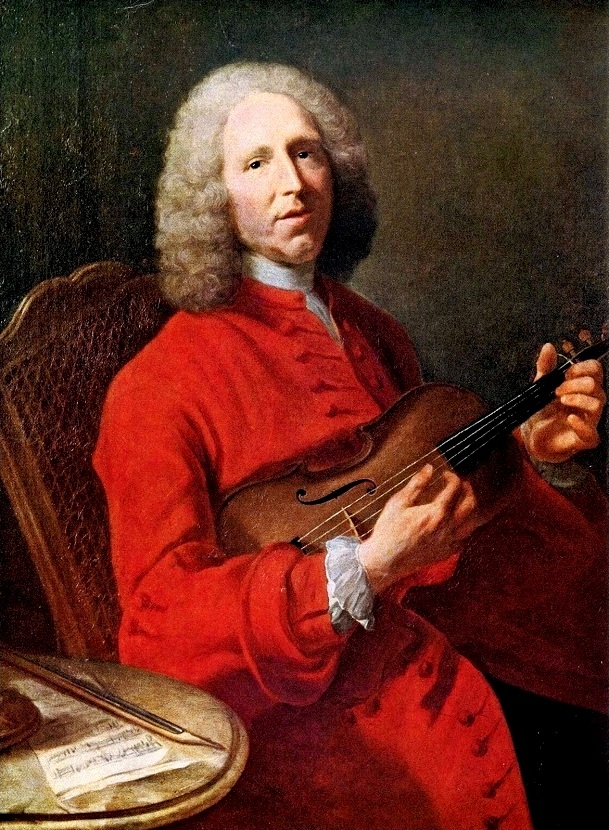
Attributed to Joseph Aved, Public domain, via Wikimedia Commons
While usually considered a Baroque composer, Jean-Philippe Rameau kept company with Enlightenment philosophers and laid the theoretical groundwork for the music of the Classical Period, so he may be better understood as a transitional figure. Born on September 25, 1683, in Dijon, France, he was educated by Jesuits and initially planned to study law, but was interested in music from a young age; he got into trouble at school when he kept interrupting class with his singing. His father sent him to study in Milan and he learned to play the violin.
He returned home and briefly moved to Paris in 1706, where he published Pièces de Clavecin and gained a reputation as a harpsichord composer. In 1715, he signed a 29-year contract to serve as the organist at Clermont-Ferrand Cathedral, a massive, jet-black Gothic cathedral made out of lava in the south of France.
In 1722, he completed the Treatise on Harmony, a substantial work on music theory. Rameau wanted to move to Paris to publish the treatise, but in order to do this, he had to get out of his absurdly long contract with Clermont-Ferrand, so he began using his knowledge of music theory to play the organ so badly that they released him. He moved to Paris, published the treatise, and was soon France’s preeminent music theorist. The Treatise on Harmony argues for the concept of fundamental bass, shifting from a consonance-first approach to a chord-first approach to musical analysis. Rameau also argues, controversially, that melody is nothing but a subset of harmony.
In 1726, Rameau (then 42) married the nineteen-year-old Marie-Louise Mangot, a singer from Lyon. They had two boys and two girls and were, by all accounts, quite happy together.
When he was almost fifty years old, Rameau decided to enter the world of opera, publishing Hippolyte et Aricie in 1733. It was successful and drew comparisons to Lully, sometimes positively and sometimes negatively. Rameau became firmly established as a leader in the French musical world.
In 1745, teamed up with the philosopher Voltaire to produce the opera Le Temple de la Gloire, in celebration of France's victory at the Battle of Fontenoy in the War of Austrian Succession. The pair were then commissioned by the Duke of Richelieu to write a comédie-ballet (essentially a musical) La princesse de Navarre.
That same year, the writer and philosopher Jean-Jacques Rousseau submitted an opera, Les muses galantes, to Rameau. Rameau disparaged the work and accused Rousseau of plagiarism. After this, the Duke of Richelieu commissioned Rousseau to turn La Princesse de Navarre into an opera, because Voltaire and Rameau were too busy (or at least too important) to do the tedious editing work. When the opera premiered, however, Rousseau’s name was left completely out of the program, further embittering him.
In 1752, when La serve padrona, an Italian comic opera by Giovanni Batista Pergolesi, was performed at the Royal Academy of Music, a dispute emerged among French cultural elite. Rousseau, still bitter against the French musical establishment, published a pamphlet entitled “Letter on French music” in which he argued that the French language is impossible to set to music, forcing French composers to rely on harmony instead of melody, and specifically calling out Hippolyte et Aricie as an example of bad music. Rameau and many others penned responses to this in what became known as the “Querelle des Bouffons” or Quarrel of the Comedians.
Rameau composed for the rest of his life, passing away in 1764 at the age of 81, but not before chastising the priest giving him the last rites for chanting out of tune.